Projects

Research made tangible.

Current work and selected previous projects spanning immersive analytics, scientific software, machine learning, astronomical instrumentation and astronomy education research.

Current projects

Active research and development.

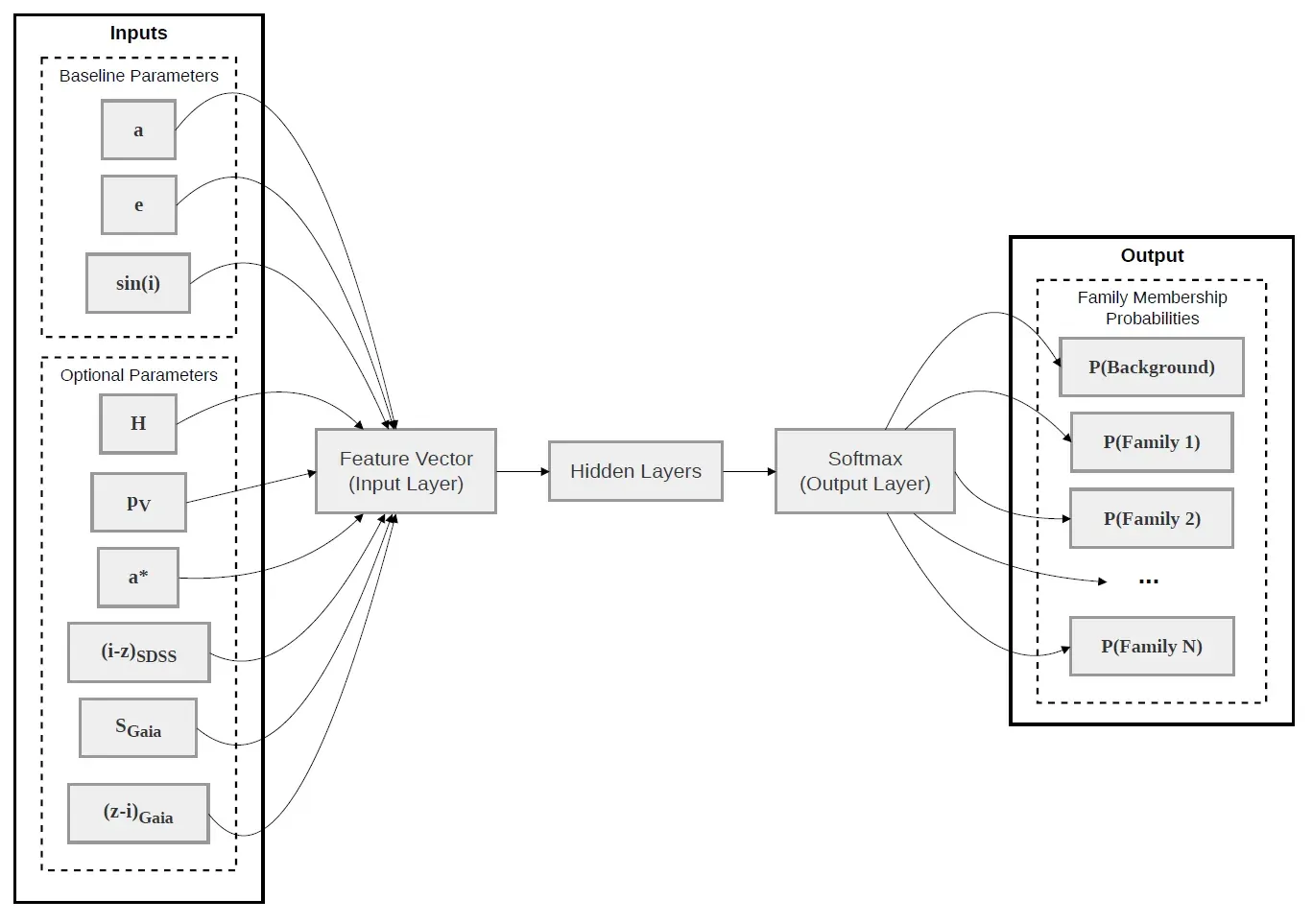
A visualisation of asteroid-family structure and machine-learning classification
January 2025 - PresentArmagh Observatory & Planetarium

Asteroid-family machine learning

Machine-learning methods for identifying asteroid families formed through disruptive events over the history of the Solar System.

  • Planetary science
  • Artificial neural networks
  • Asteroid families
  • Synthetic data
  • Immersive analytics
Read project overview

The project develops, optimises and validates artificial neural networks designed to identify groups of asteroids that share a common origin.

Alongside the machine-learning work, I am exploring immersive visualisation methods for interrogating both real and synthetic training data, with the aim of making model behaviour and classification structure easier to inspect.

This creates a human-in-the-loop workflow in which statistical methods and visual reasoning support one another rather than operating as separate stages of the analysis.

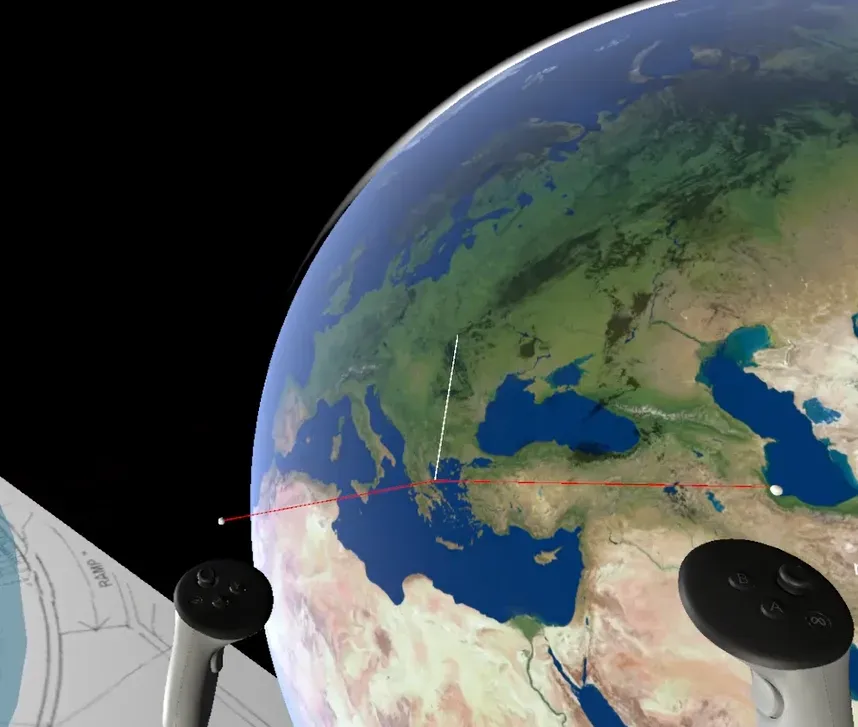
A virtual-reality interface controlling scientific content inside a digital dome theatre
June 2019 - PresentArmagh Observatory & Planetarium

VR2Dome

A research and development programme joining the intuitive navigation of virtual reality with the shared, collaborative environment of a digital dome theatre.

  • Collaborative immersion
  • Digital domes
  • Virtual reality
  • Digital twins
  • Human-in-the-loop systems
Read project overview

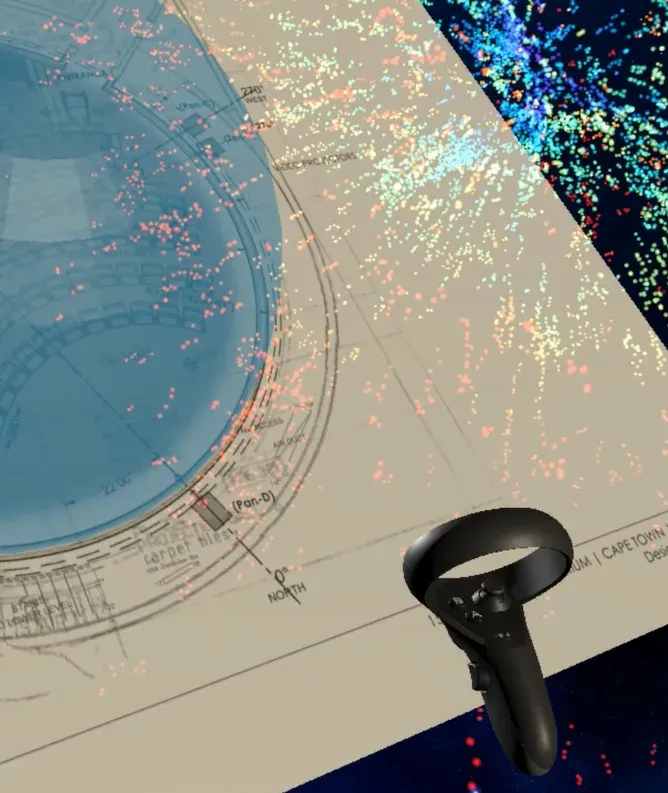
VR2Dome builds on my doctoral work in digital-planetarium interaction and my professional experience in immersive data visualisation. It explores new methods for interacting with large-scale immersive data environments, with a focus on accessibility, collaboration, scientific utility and digital-twin approaches for immersive facilities.

The concept bridges the strengths of VR and the dome: a researcher can navigate and select data through an intuitive individual interface while a group shares the resulting view and analysis inside the theatre. This lowers barriers to scientific use without losing the dome's value for education and public engagement.

The current phase is exploring how VR2Dome could develop into a human-in-the-loop digital twin of a planetarium, linking a virtual representation of the dome to live or simulated system state and, potentially, bidirectional control for monitoring, rehearsal, operation and collaborative analysis.

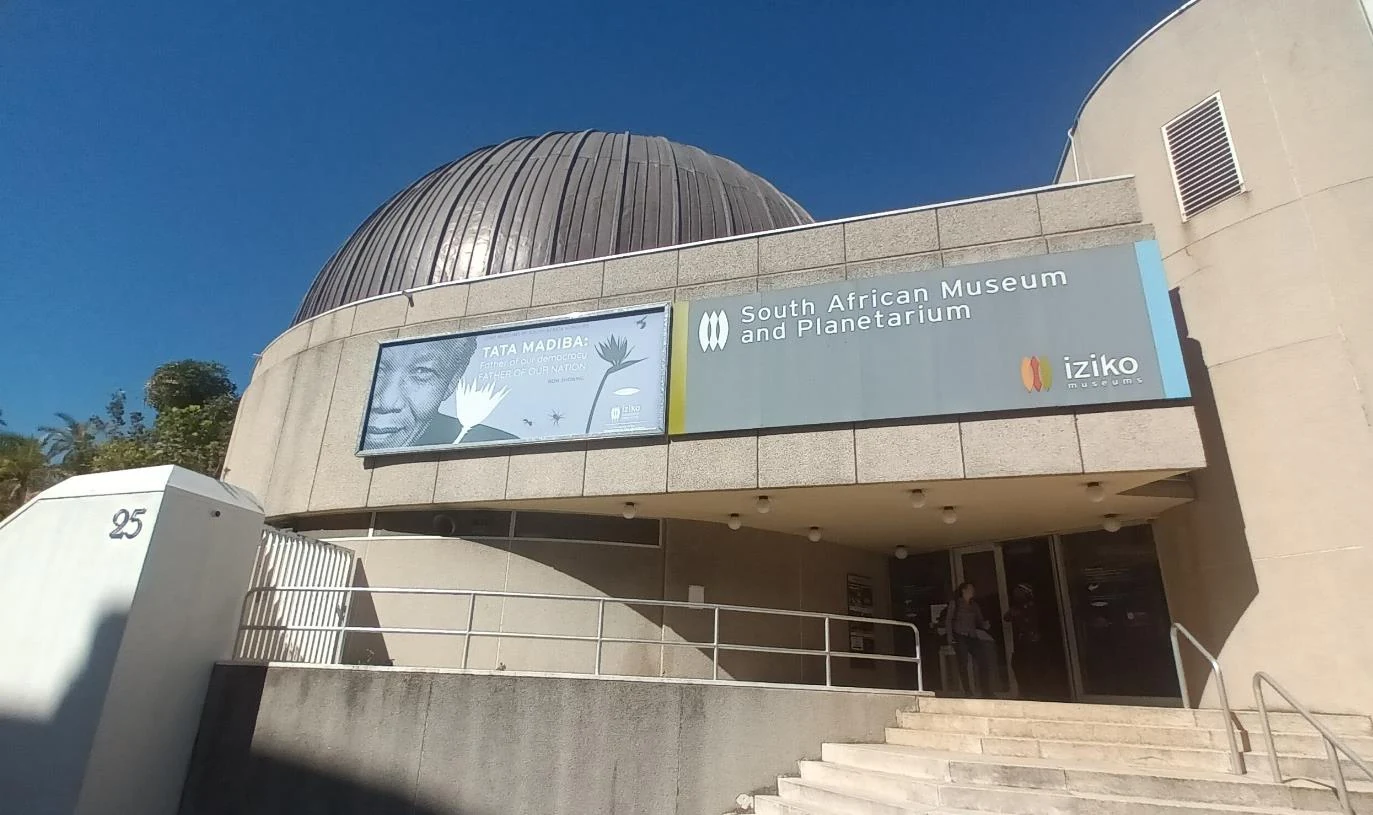
Early proof-of-concept demonstrations were developed with IDIA and Iziko Planetarium in Cape Town and presented at data-visualisation workshops. A live demonstration at the 2019 Data to Dome Workshop was later highlighted in the President's Message of The Planetarian.

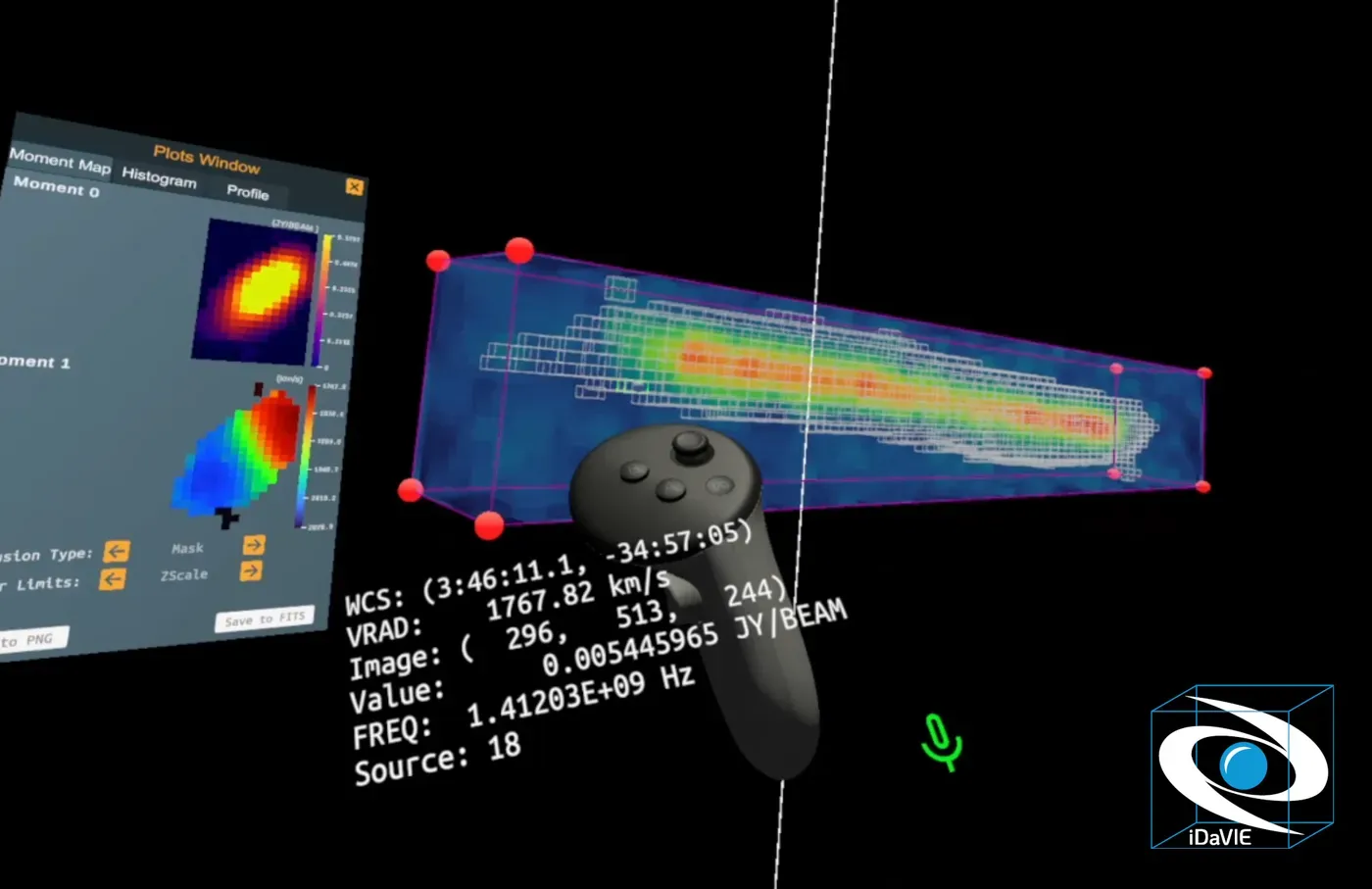
A researcher exploring a three-dimensional astronomical data cube inside iDaVIE
May 2018 - PresentIDIA — Inter-University Institute for Data Intensive Astronomy

iDaVIE

An open-source virtual-reality software suite for interactive exploration and analysis of volumetric data cubes and multidimensional catalogues.

  • Scientific software
  • Volumetric rendering
  • Virtual reality
  • Radio astronomy
  • Multidimensional data
Read project overview

As lead developer, I work across the iDaVIE software suite. Its principal tools render scientific datasets in a room-scale immersive environment where users can navigate, select, inspect and edit structures directly in three dimensions.

The interaction model is designed to reduce the additional mental work involved in reasoning about 3D structures through conventional 2D interfaces, allowing researchers to focus more directly on scientific relationships and anomalies.

I also lead the iDaVIE-d prototype, which brings the rendering and interaction capabilities of the VR environment into the digital planetarium.

Although astronomy remains the primary application, the platform has also supported exploratory work with datasets from neuroscience, chemical engineering and astrobiology. iDaVIE-v is developed in collaboration with INAF-OAC.

Earth-observation data displayed across virtual-reality and digital-dome environments
March 2026 - PresentArmagh Observatory & Planetarium

SpaceDome

An ESA-funded immersive platform for exploring Copernicus Earth-observation data through connected virtual-reality and digital-dome environments.

  • Earth observation
  • Copernicus data
  • Spatial computing
  • AI orchestration
  • VR and digital domes
Read project overview

SpaceDome combines real-time geospatial data, AI orchestration and spatial computing to support intuitive interaction with large Earth-observation datasets.

My role covers technical direction across the platform, including system architecture, data pipelines, visualisation workflows and the integration of individual VR exploration with collaborative digital-dome experiences.

The work also explores natural-language interfaces and AI-assisted navigation so that users can interrogate complex scientific information without losing the human role in directing and interpreting the analysis.
Selected previous work

Completed projects that shaped the current work.

Students taking part in an astronomy learning experience inside a digital planetarium
PhD project · 2018 - 2023University of Cape Town

Characterising the Digital Planetarium as a Teaching and Learning Space

Doctoral research investigating how students engage with a digital planetarium, what shapes the learning environment and how those findings can guide curriculum design.

  • Astronomy education research
  • Grounded Theory Method
  • Cognitive Load Theory
  • Digital planetariums
  • Curriculum design
Read project overview

The study combined student responses from two university planetarium visits with detailed observational data. I designed the response instrument, created show content for the second visit and analysed both datasets using the Grounded Theory Method.

The student data produced a localised model centred on a spectrum of attentiveness that strongly influenced engagement. The observational data produced a second model describing the contextual factors that shape the planetarium teaching and learning space.

I then connected the localised models with Working Memory and Cognitive Load Theory to develop the Model for Curriculum Design in the Planetarium, or MCDiP: a systematic framework for shaping the digital planetarium as an effective teaching and learning environment.

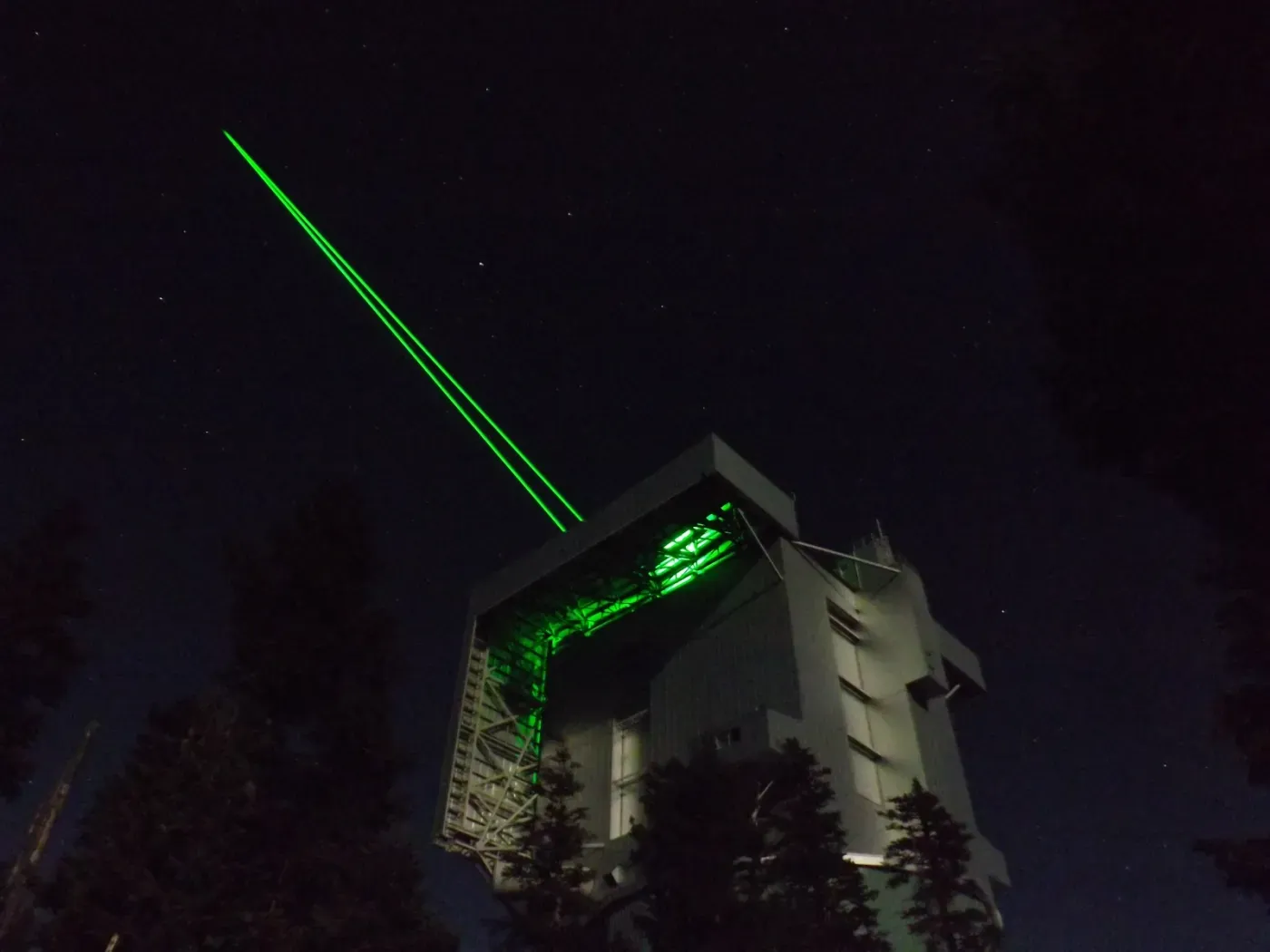
The ARGOS laser guide stars and Laser Alignment Telescope at the Large Binocular Telescope
May 2015 - June 2016Max Planck Institute for Astronomy

Laser Alignment Telescope at the Large Binocular Telescope

A purpose-built telescope and open-source image-analysis system for automatically locating and aligning the ARGOS laser guide stars.

  • Adaptive optics
  • Astronomical instrumentation
  • Computer vision
  • Laser guide stars
  • Open-source software
Read project overview

As part of the Advanced Rayleigh Guided Ground Layer Adaptive Optics System, I led development of the Laser Alignment Telescope used to detect the initial positions of the guide lasers on sky and align them with the optical axis.

The work combined instrument design, construction, programming, installation and commissioning at the Large Binocular Telescope Observatory in Arizona.

The automated alignment approach was released as the open-source Collimating Smart Laser Alignment Algorithm, or ColSLAA, which uses LAT images to determine the pointing directions of the guide stars.

Research outputs

Looking for the papers?

View publications