Real-time 3D and VR software · Active project
iDaVIE: virtual reality for volumetric scientific data
An open-source Unity and SteamVR application for interactive analysis of 3D data cubes, released at version 1.0 and used by external research groups to correct source-detection masks and publish discoveries.
- Status
- Current
- Dates
- May 2018 - Present
- Institution
- IDIA · Inter-University Institute for Data Intensive Astronomy
- Stack
- Unity · SteamVR · C++ · HLSL
- Role
- Lead Developer
Overview
Data that stopped fitting on a flat screen.
Radio telescopes such as MeerKAT, ASKAP and APERTIF now produce spectral cubes with the same number of spatial pixels as a decade ago but up to 32,000 spectral channels. Assessing a cube like that one slice at a time is no longer practical, and the structures that matter most, the kinematic ones, are exactly those a stack of 2D projections hides.
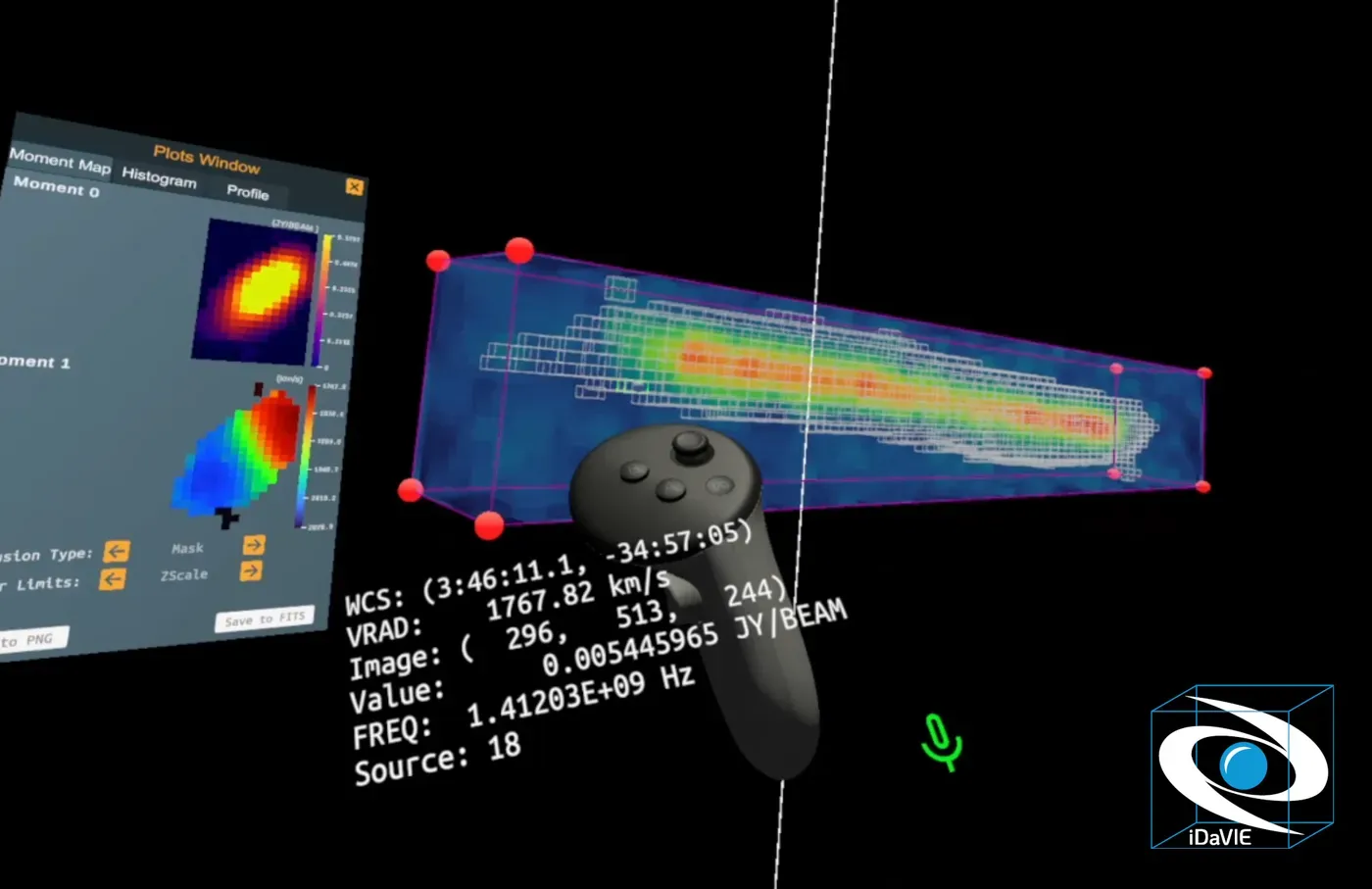
iDaVIE renders the whole volume in room-scale virtual reality, where navigating, selecting, masking and measuring happen directly in three dimensions. It is built to sit inside an existing workflow rather than replace it: it reads standard FITS cubes and masks, imports VOTable catalogues, and exports edited masks, cropped subcubes, moment maps and spectral profiles back into the formats the rest of the pipeline expects.
The design rule throughout was to add an immersive interface only where it earns its place. File loading, parameter tuning and debugging stay on the desktop, where a keyboard is better. Navigation, selection and mask painting move into VR, where the flat screen is the bottleneck.
My role
Lead developer since the first prototype.
I have worked on iDaVIE since 2018, from the original room-scale proof of concept through to the version 1.0 release. I am first author and corresponding author on the software paper, credited for software, methodology, validation and conceptualisation.
- Built the native C++ plug-in layer that parses FITS, handles World Coordinate System transformations and computes statistics and downsampling.
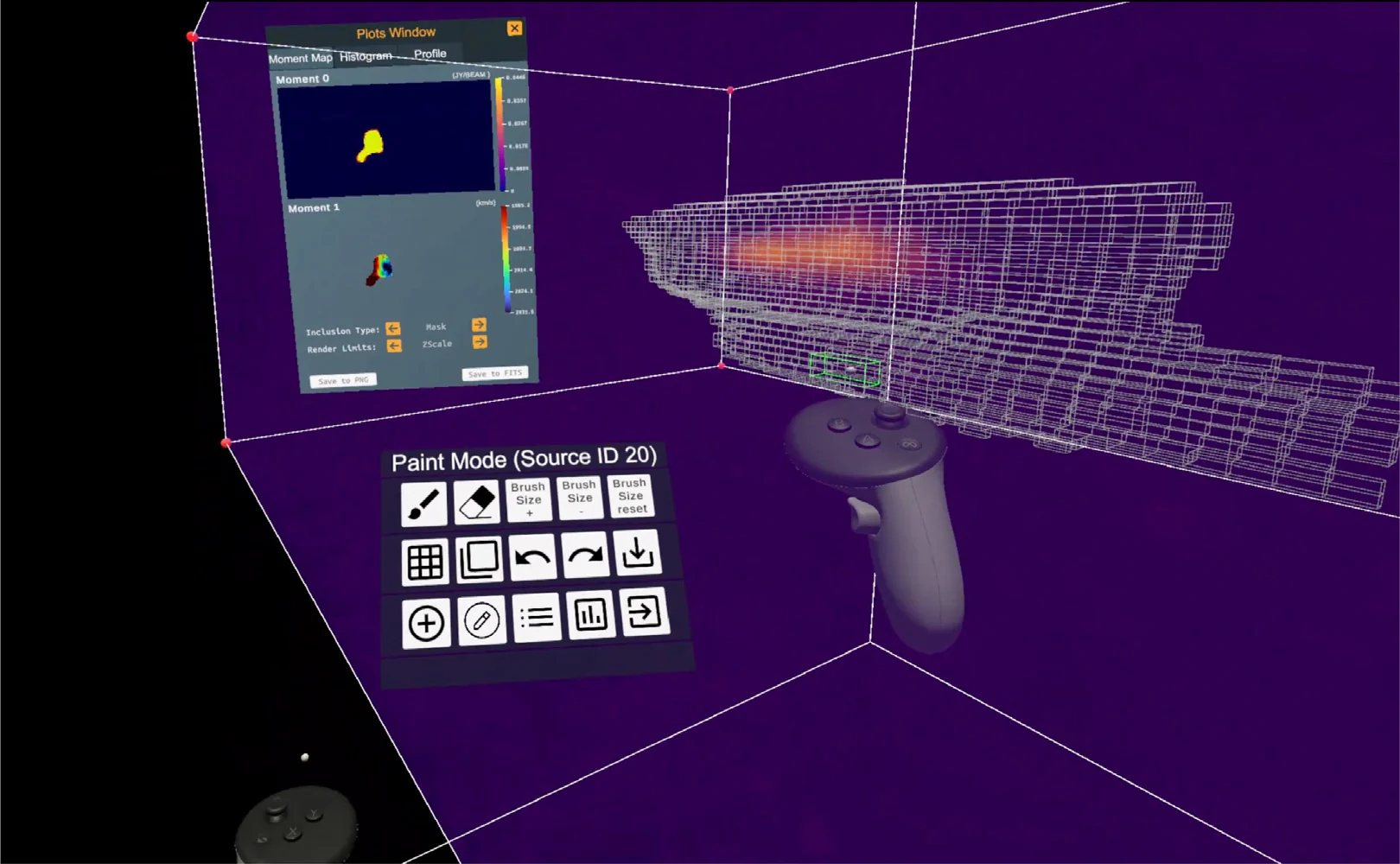
- Designed the interaction model, including the locomotion and interaction state machines, the selection and mask-painting tools and the voice-command layer.
- Worked on the HLSL ray-marching shader and the rendering trade-offs that keep large cubes inside the VR comfort threshold.
- Coordinated releases, documentation and user support across an international collaboration, and supervised eight honours and MSc students contributing to the codebase.
- Lead the iDaVIE-d prototype, which extends the rendering and interaction stack into the digital planetarium.
System design
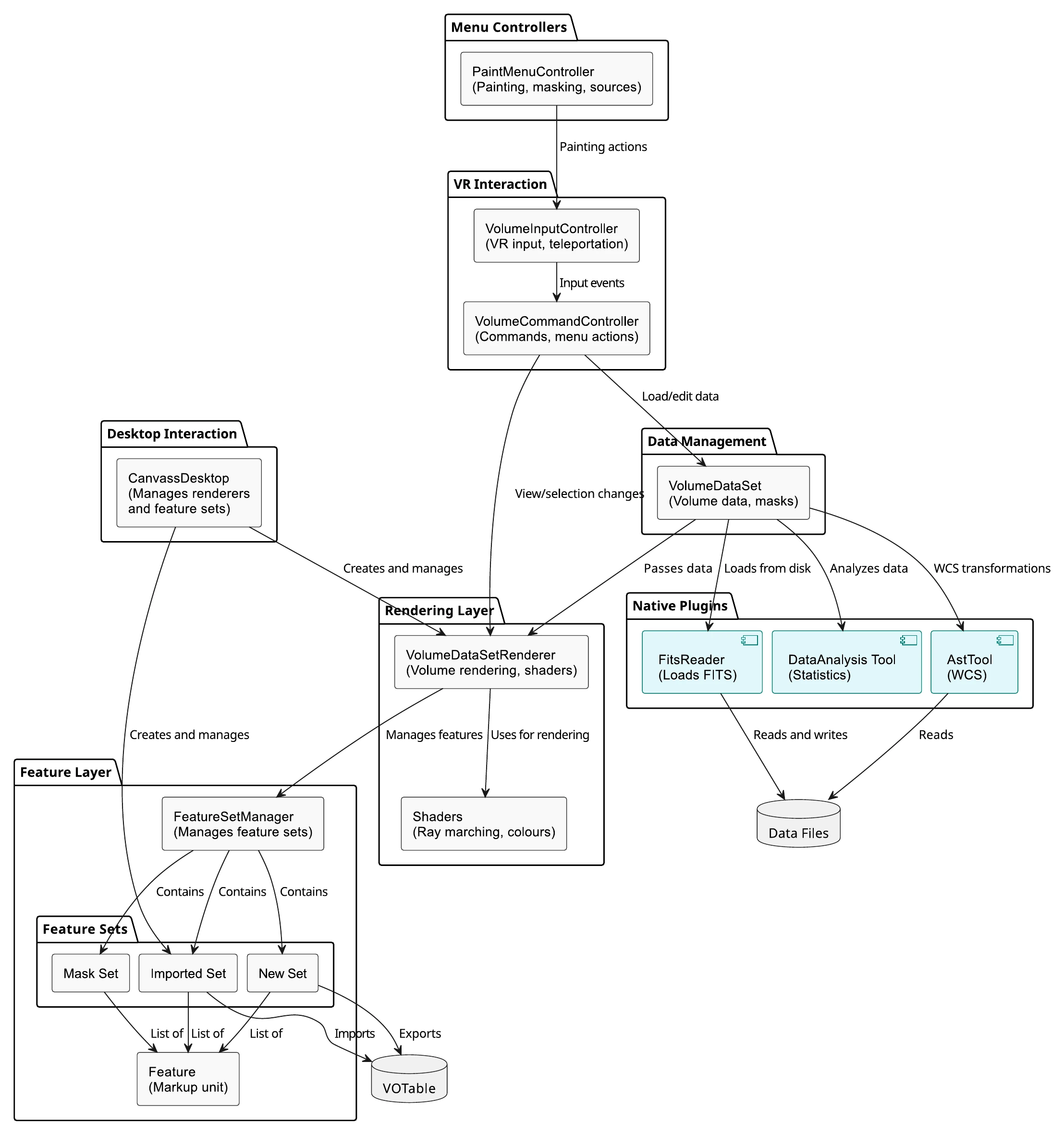
Three layers behind a single Unity scene.
Native plug-ins
C++ libraries compiled to a native DLL and bound into Unity through C# interface classes. FitsReader parses cubes through CFITSIO, AstTool resolves coordinates and units through AstLib, and DataAnalysis handles statistics and downsampling.
Rendering layer
A custom HLSL shader on Unity's Built-In Render Pipeline ray-marches the 3D texture, using ray-box intersection to bound each ray and a maximum or mean transfer function along the interval, then applies a Matplotlib-derived colourmap with value-normalised alpha.
Interaction and Features
Two state machines separate locomotion from interaction. A Feature system marks regions of interest, whether derived from a loaded mask, imported from a VOTable catalogue or created by hand in VR, and exports them back out as catalogues.
Engineering
Fitting arbitrarily large cubes into a fixed texture budget.
Unity's hard ceiling on a single texture is 4 GB, a consequence of 32-bit memory addressing. In practice the binding limit is far lower. iDaVIE defaults to 368 MB, a figure arrived at by trial and error against rendering performance rather than derived from the hardware, and adjustable in configuration for stronger GPUs.
The reason the limit is a correctness requirement rather than a performance target is the 90 Hz VR comfort threshold. Below it, users get sick. That constraint pushes the expensive work out of the frame and into the load pipeline.
Parse the cube natively
The FitsReader plug-in reads the FITS file into a float buffer outside the managed heap. Four-dimensional cubes have their spectral axis resolved automatically where it is unambiguous, and the user is prompted where it is not.
Search for downsampling factors that fit
Three per-axis factors start at 1, 1, 1 and increment until the resulting texture falls under the budget, alternating between the two spatial axes and the spectral one so the cube degrades evenly rather than collapsing along a single dimension.
Aggregate in parallel
Each output voxel becomes the mean or the maximum of its corresponding block in the source cube, selected by configuration. The largest cube benchmarked, 1536³, reduces to a 384 × 384 × 512 texture.
Keep the full resolution resident
The full-resolution cube and mask stay in RAM. When a user crops to a region small enough to fit the budget, downsampling is skipped entirely and they get the real voxels, then can switch back to the overview without touching the disk again.
Rendering findings
Two results worth writing down.
Framerate is anisotropic
Looking down the y and z axes measurably underperforms looking down x, because of how the 3D texture is laid out in memory and how the ray-marcher walks it: fewer cache hits along the slower directions. This is worth documenting, because a user who benchmarks their hardware from one viewing angle will overestimate the cube size it can carry.
Bilinear filtering is off on purpose
Unity smooths 3D textures by default, and the smoothed render looks better. It also blurs the boundary between adjacent voxel values, which is precisely the distinction the science depends on. Filtering is disabled by default: we chose the blockier image.
Performance
Holding 90 Hz as the cube grows.
Median framerate stays close to the headset refresh rate across a sixfold range of native cube dimensions, because the adaptive downsampling absorbs the growth before the renderer sees it. The real cost of a larger dataset shows up in load time and memory instead: the 1536³ cube takes 45 seconds to load and peaks around 22 GB of private memory, against 2.9 seconds and 3.2 GB for a representative science cube.
| Cube | Native dimensions | Median fps | Minimum fps |
|---|---|---|---|
| Synthetic S | 256³ | 90.5 | 38.3 |
| Synthetic M | 512³ | 89.3 | 35.2 |
| Synthetic L | 1024³ | 88.7 | 39.1 |
| Synthetic XL | 1536³ | 88.9 | 35.0 |
| Science (Fornax HI) | 1046 × 952 × 398 | 90.6 | 42.3 |
Project media
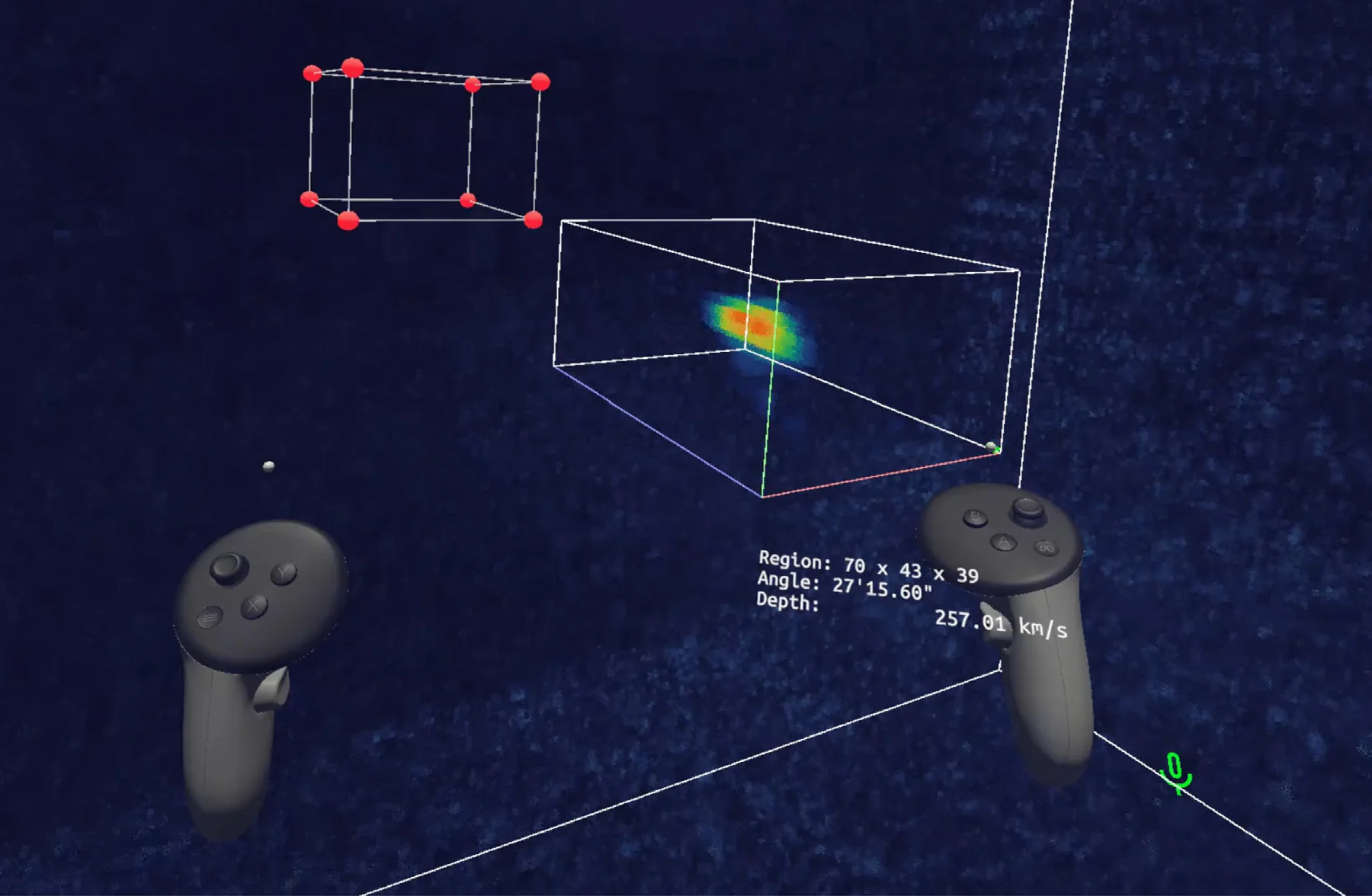
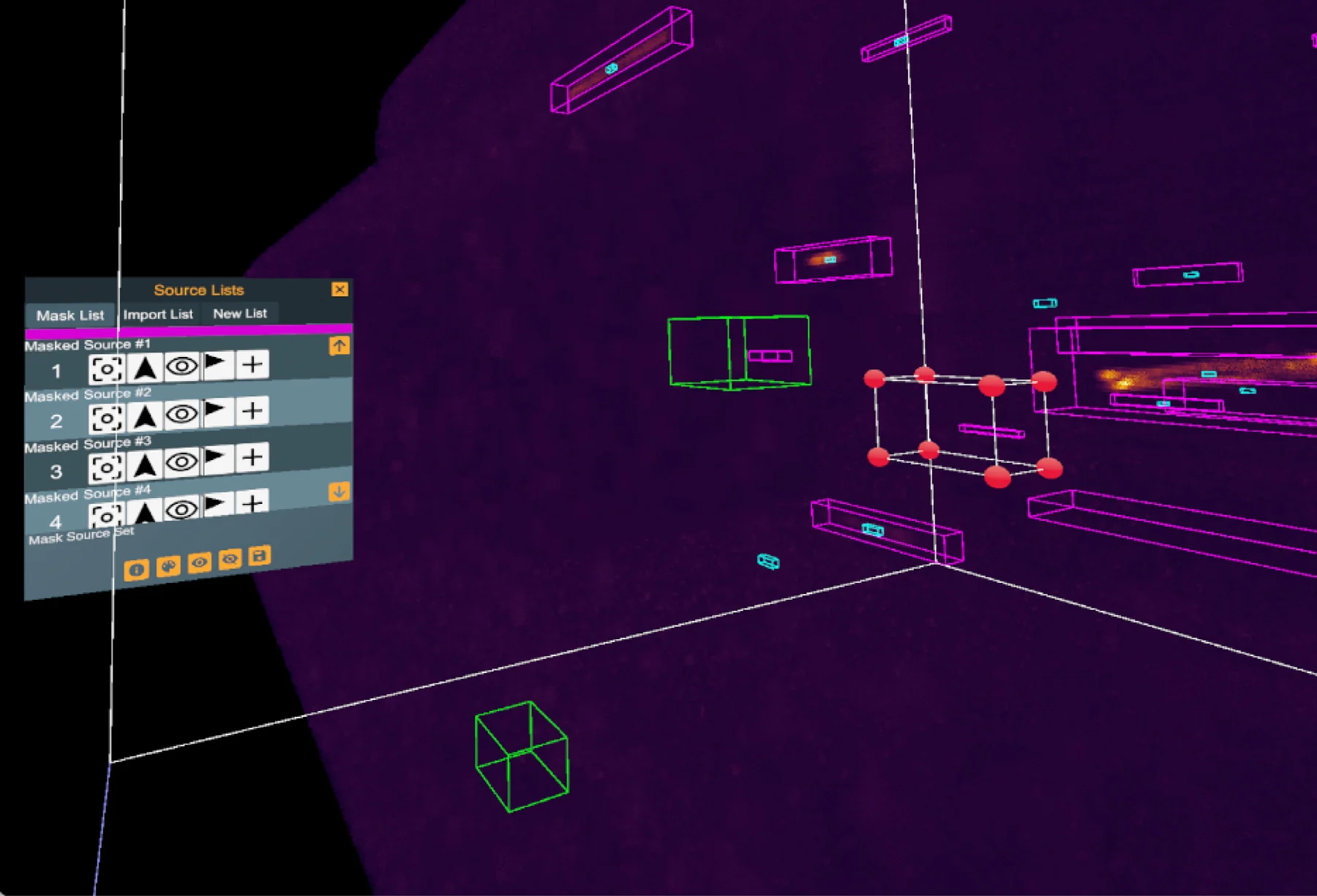
Selection, masking and catalogues.
Outcomes
Results other groups published using the tool.
Fornax A group
Refining a SoFiA detection mask in iDaVIE added two neutral hydrogen sources that automated reliability thresholds had excluded, and removed spurious ones (Kleiner et al. 2021).
MeerKAT Fornax Survey
Visual verification across angular and velocity scales guided the clean mask behind the first evidence of ram pressure shaping the distribution of neutral hydrogen in a Fornax cluster galaxy (Serra et al. 2023).
WALLABY polar rings
The mask-painting tool isolated anomalous gas from the galactic disks of two polar ring galaxies, NGC 4632 and NGC 6156, for follow-up kinematic modelling (Deg et al. 2023).
Release
Version 1.0 under the GNU LGPL v3, registered in the Astrophysics Source Code Library as ascl:2607.010, archived on Zenodo, and published in Astronomy and Computing 56, 101109.
Limitations and future work
What version 1.0 does not yet do.
Loading is all-or-nothing: a full 3D cube from a single header data unit. Very large cubes therefore cost long load times and enough downsampling to wash out features before the user can crop in. Memory scales with the full cube rather than the texture, so insufficient RAM sends the operating system to disk. Subcube bounds and HDU selection are the main targets for version 1.1.
The default maximum-value transfer function serves users looking for bright emission, but it discards absorption features even when they are statistically significant. A hybrid function that takes whichever of the maximum or minimum is larger in absolute value would address this, and a radiative-transfer-based shader would go further.
Visualisation and analysis are still tightly coupled inside the native plug-ins. Separating them so that analysis can arrive as third-party plug-ins is what would let other disciplines adopt the renderer without inheriting the astronomy.
Collaboration
Built across five countries.
iDaVIE is developed at the Inter-University Institute for Data Intensive Astronomy with collaborators across South Africa, Italy, the Netherlands, the United States and the United Kingdom. The version 1.0 paper carries twelve authors, and iDaVIE-v is developed in collaboration with INAF Osservatorio Astrofisico di Catania.
Although astronomy remains the primary application, the platform has also supported exploratory work with datasets from neuroscience, chemical engineering and astrobiology.
Resources