Optical instrumentation and control software · Completed project
Laser Alignment Telescope and Smart Laser Alignment
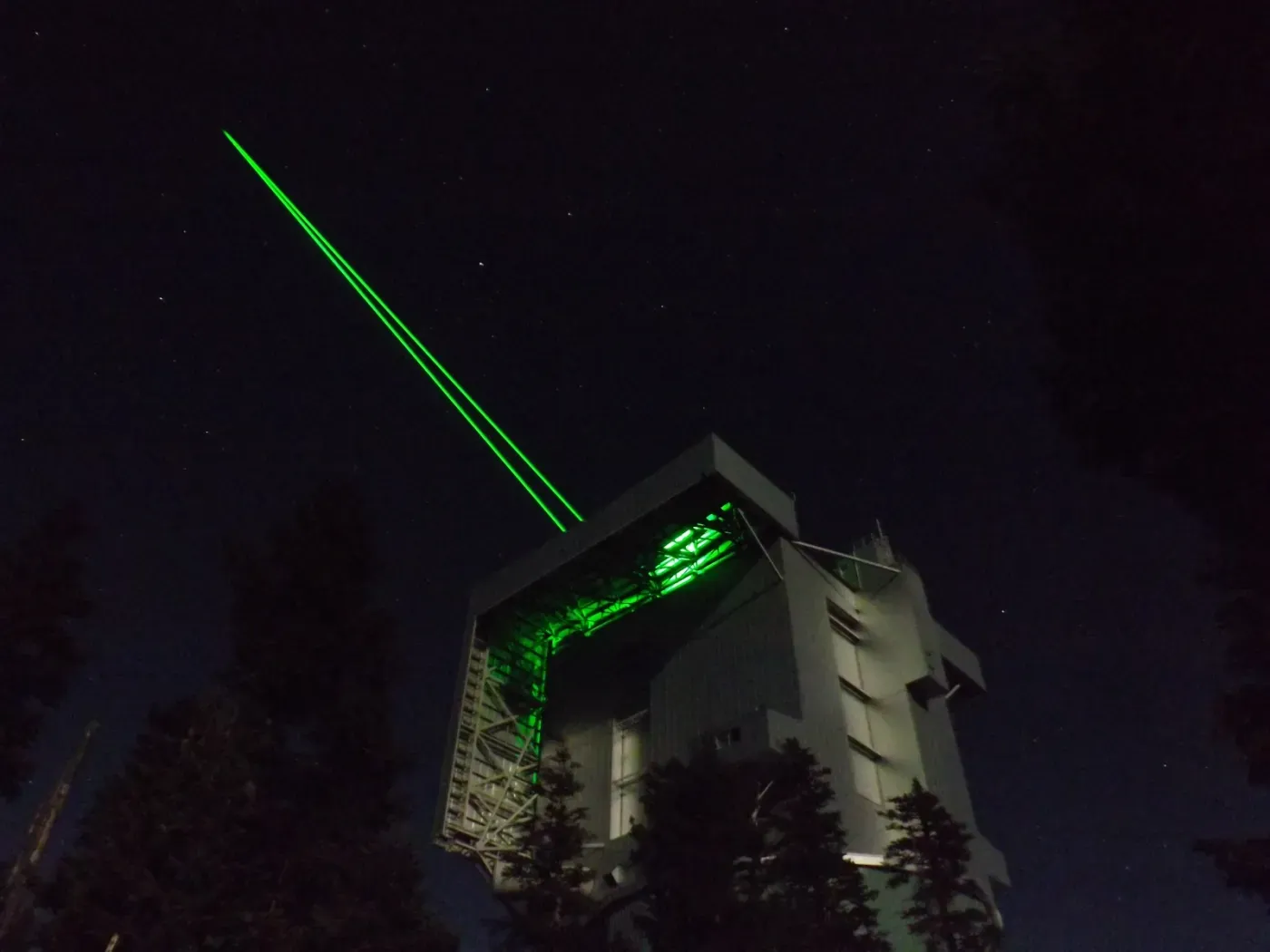
A purpose-built telescope and computer-vision workflow developed to locate and coarsely align the six ARGOS Rayleigh laser guide stars at the Large Binocular Telescope.
- Status
- Completed
- Dates
- Master's project · May 2015 - June 2016
- Institution
- Max Planck Institute for Astronomy · Heidelberg University
- Context
- ARGOS · Large Binocular Telescope
- Role
- Research assistant and master's researcher
Overview
From manual acquisition to a repeatable workflow.
The Advanced Rayleigh guided Ground layer adaptive Optics System (ARGOS) uses three laser guide stars for each of the Large Binocular Telescope's two mirrors. These artificial reference stars allow the system to measure atmospheric distortion across a wide field and improve the observations delivered to its scientific instruments.
Before ARGOS can make those measurements, the light returned from each laser at an altitude of 12 kilometres must fall close enough to its wavefront sensor for the acquisition system to see it. Telescope flexure and maintenance could move the beams outside that capture range, leaving the team to recover them through a time-consuming manual search.
The project addressed that operational gap as a connected instrument-and-software problem. The Laser Alignment Telescope (LAT) supplied a wide-field image of the launched beams. The Smart Laser Alignment (SLA) software then detected their geometry, estimated the required correction and passed that correction into the ARGOS control system.
My role
Work across optics, control software and image analysis.
I was responsible for the end-to-end development of the LAT and its alignment workflow as part of my master's research and subsequent work with the ARGOS group at the Max Planck Institute for Astronomy. The work moved from requirements and prototyping through installation and commissioning at the Large Binocular Telescope Observatory.
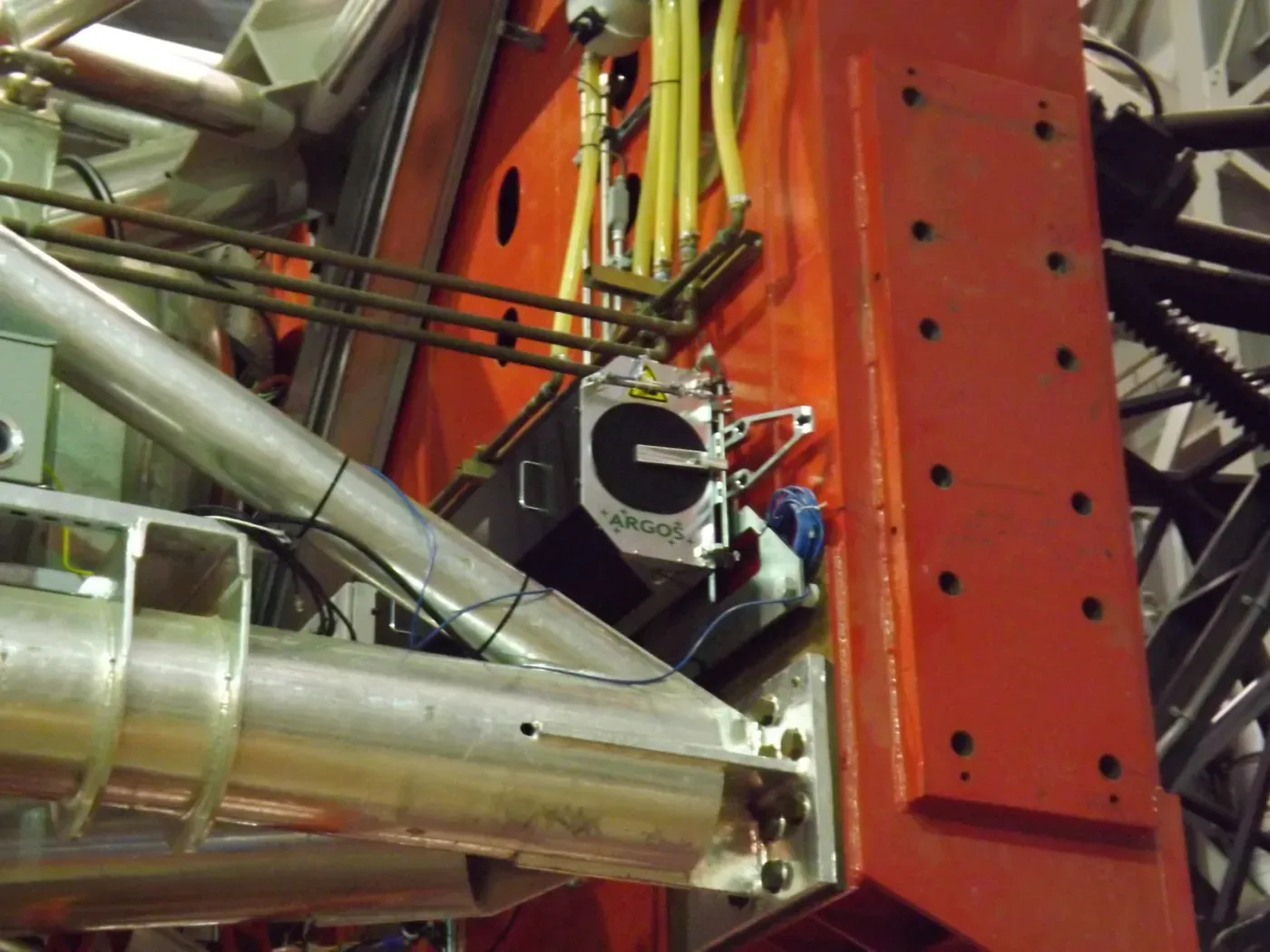
- Selected, assembled and tested the telescope, camera, electronic focus system, protective housing and dust shutter.
- Developed the networked control software for image acquisition, camera settings, focus control and shutter operation.
- Designed and implemented the Python image-analysis and alignment workflow.
- Calibrated the telescope-to-laser coordinate transformation and modelled relative flexure across telescope elevation.
- Supported installation, on-sky testing, commissioning and integration with the wider ARGOS software architecture.
System design
One workflow, three connected layers.
Laser Alignment Telescope
A 152 mm refractor and 2048 × 2048-pixel camera combined a roughly one-degree field with a pixel scale of about 1.7 arcseconds per pixel. The instrument was mounted in a protective, adjustable housing on the telescope structure.
Control software
A client-server interface controlled the camera, motorised focus and dust shutter over the observatory network. The same interface supported ARGOS integration and more general use of the LAT by Large Binocular Telescope staff.
Smart Laser Alignment
The Python workflow located the projected laser beams, reduced them to a stable endpoint constellation and converted an image offset into movement commands for the final laser-launch mirrors.
Approach
Turning an image into a mirror correction.
Acquire and prepare a LAT frame
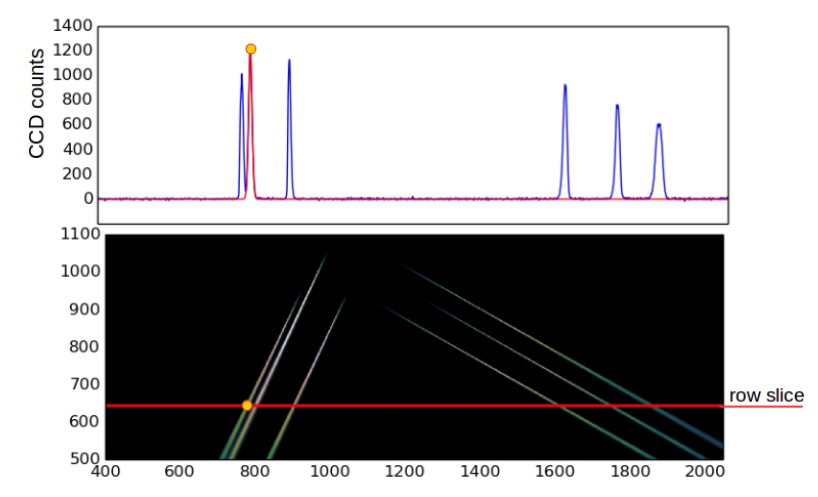
The LAT captured a wide-field image containing one or both three-beam laser constellations. Image processing reduced background structure and prepared row profiles for detection.
Find and organise the laser peaks
Repeated Gaussian fitting and subtraction identified bright peaks across image rows. A slope test associated those peaks with the expected near-parallel laser tracks and rejected inconsistent detections.
Fit the beams and locate their endpoints
Lines were fitted through the accepted points. Integrated flux profiles along those lines were used to estimate where each beam faded into the background, producing three endpoint coordinates.
Compare the constellation with a calibrated target
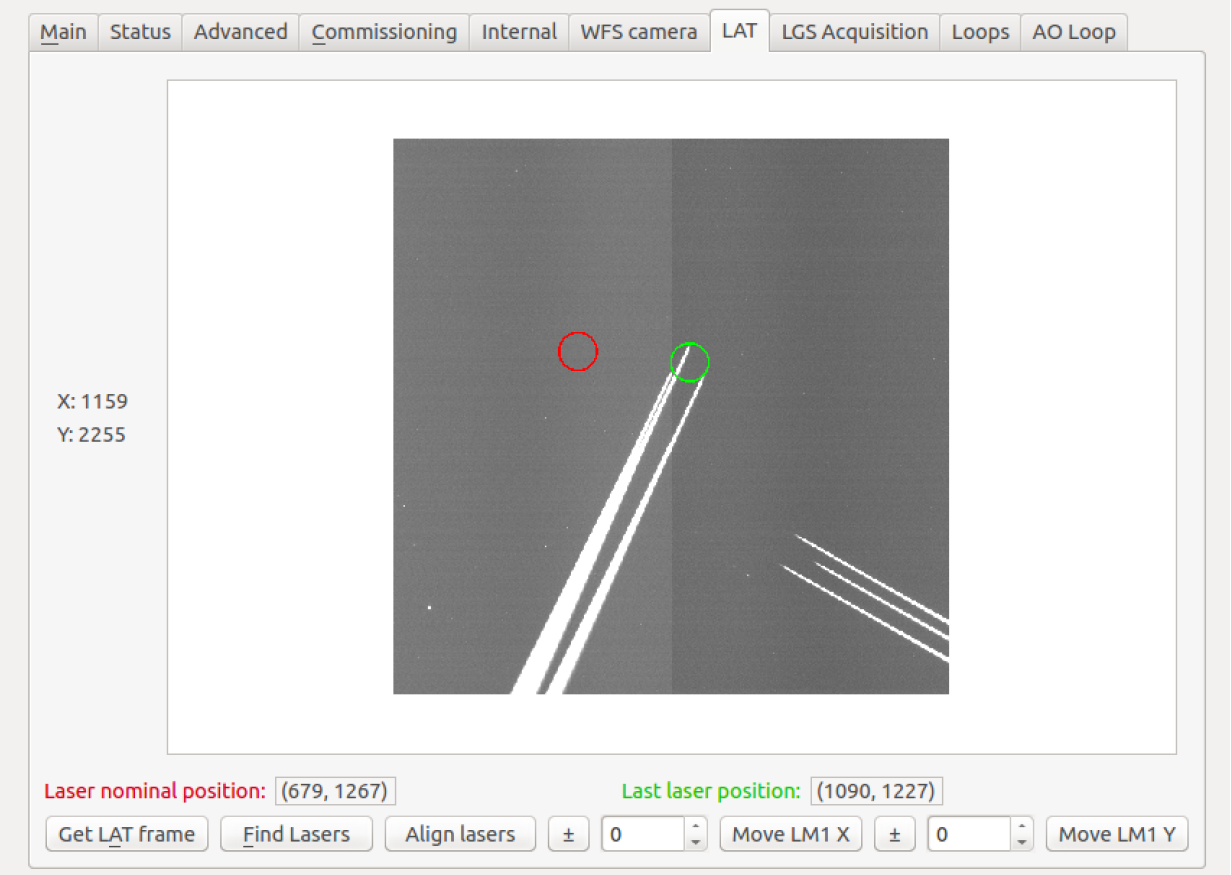
A circle fitted to the three endpoints provided a stable constellation centre. Its displacement from an elevation-corrected target represented the coarse alignment error.
Transform the offset into telescope commands
Calibration matrices converted the pixel displacement into the two movement axes of the primary launch mirror for the relevant side of the telescope. ARGOS could then apply the correction and hand over to its finer acquisition system.
Development testing
Balancing speed with reliable detection.
Three row-scanning strategies were compared on a development image set. The skeleton method found the complete laser pattern most often, but it was also the slowest. Gaussian subtraction was selected as the better compromise between speed and robustness for the integrated workflow.
| Detection method | Median time per image | Complete-detection rate | Decision |
|---|---|---|---|
| Sideways threshold | 2.4 s | 72% | Not selected |
| Skeleton | 7.2 s | 96% | Not selected |
| Gaussian subtraction | 4.1 s | 92% | Selected |
Project media
Instrument, analysis and integration.
Outcomes
A commissioned system with documented trade-offs.
Instrument and integration
The LAT was built, installed and aligned on the Large Binocular Telescope, replacing the ageing Mount Alignment Telescope. Its control software and the SLA workflow were integrated into the ARGOS software environment, including visual controls and a manual fallback.
Commissioning benefit
At the time of completion, we estimated three hours of accumulated alignment time saved across ten days of laser use during two commissioning runs. This is a project-specific estimate, not a claim about later or current observatory operations.
Open implementation
The image-analysis work was released as open-source scientific software, preserving the detection and alignment methods for inspection, reuse and further development.
Engineering lessons
Commissioning exposed practical limits in the focus mechanism, optical collimation, aberrations and relative flexure. Rather than hiding those issues, the thesis documented them alongside repairs, compensation models and proposed hardware improvements.
Limitations and future work
What remained beyond the original project.
Relative flexure between the LAT and the main telescope exceeded the 30-arcsecond capture budget across the ARGOS operating elevation range, so the target position required an elevation-dependent correction. A friction-drive problem in the original focus mechanism also required repair and motivated a more robust rack-and-pinion replacement.
The project explored, but did not complete, an atmospheric height-analysis method based on beam geometry and Rayleigh-scattered light. That extension was intended to make endpoint interpretation more robust in cloudy conditions and was explicitly left as future work.
Collaboration
Developed within the ARGOS team.
The project was carried out at the Max Planck Institute for Astronomy under the supervision of Klaus Meisenheimer and with Wolfgang Gässler as project mentor. Software, calibration, integration and commissioning support came from colleagues across the ARGOS collaboration and the Large Binocular Telescope Observatory, including José Luis Borelli, Martin Kulas, Lorenzo Busoni, Marco Bonaglia, Sebastian Rabien and the wider observatory team.
Resources